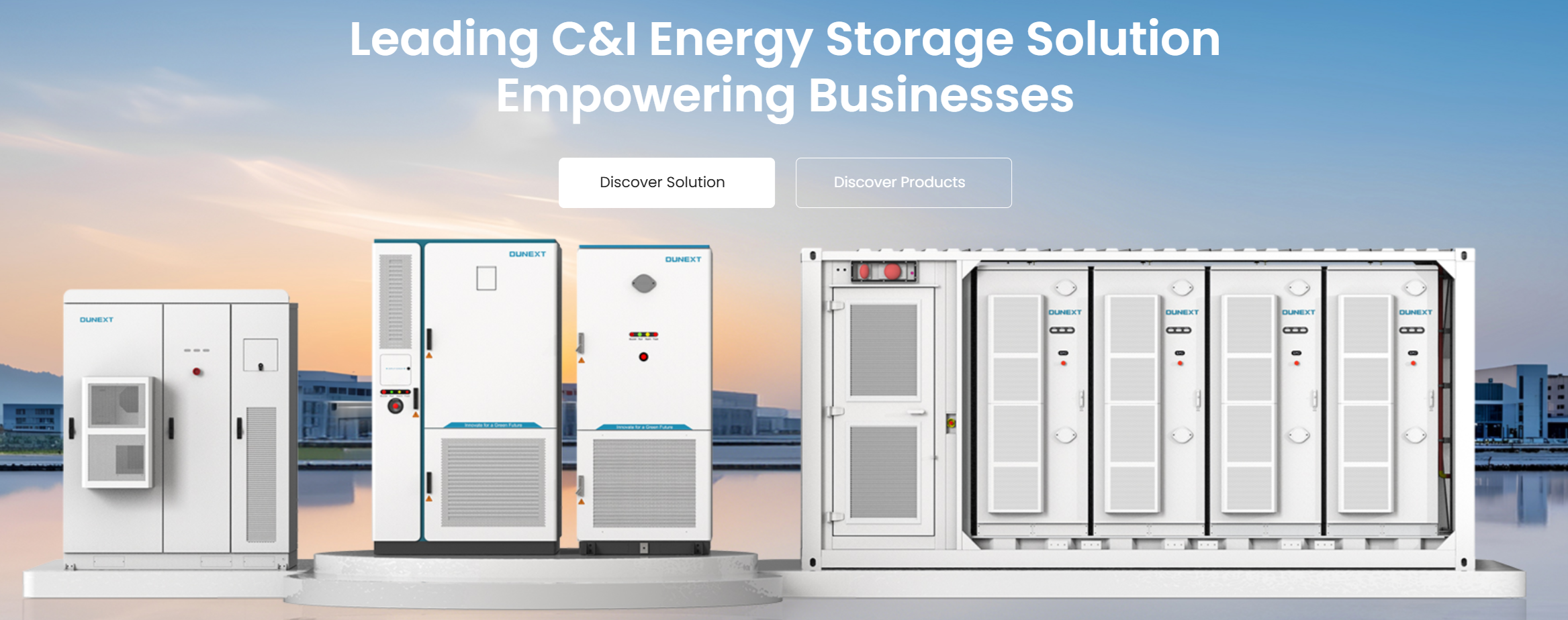
A quiet wager
I compare them because the choice hides costs and opportunities. A rooftop pack and a megawatt-scale bank look like cousins until you strip away scale, control, and risk. I walked a mixed-use site with a Dunext dealer, listened to an operator mutter about toggles and thresholds, and realized the decisions are surgical, not poetic.
Scale and purpose — where they split
Scale defines behavior. Commercial systems: dozens to a few hundred kilowatt-hours. Industrial BESS: megawatt-hours, grid-interactive beasts. One serves a building’s bills and resilience. The other bolsters transmission, provides frequency response, and shapes market prices. Hornsdale Power Reserve in South Australia stands as a clear reference for industrial deployments — big, fast, grid-focused. Small systems aim at predictable savings. Large systems chase multiple revenue streams and regulatory complexity.
Technical architecture and control — quiet differences that matter
Components look similar at first glance. Chemistry, cells, inverters. But architecture diverges:- Commercial: simple string inverters or single-stack PCS, modest BMS logic, factory-configured protection.- Industrial: modular racks, redundant PCS, hierarchical BMS, SCADA integration, specialized thermal management.Control matters. Commercial systems rely on scheduled scripts and local sensors. Industrial systems demand fast telemetry, adaptive dispatch, and sometimes firmware tuned to market signals. Fault modes are different. A cell imbalance on a rooftop is inconvenient. At grid scale, the same imbalance can trip protections and cascade revenue loss.
Economics and revenue — not just price per kWh
Unit price matters, but not alone. Commercial buyers evaluate payback from demand charge reduction, time-of-use shifting, and outage tolerance. Industrial operators model capacity markets, ancillary services, arbitrage, and contractual grid services. Key comparisons:- Capital intensity: commercial low, industrial high.- Return drivers: commercial operational savings; industrial multiple market mechanisms.- Financing: commercial often leased or bought; industrial relies on project finance, PPAs, or merchant exposure.Misjudge the dispatch profile and you destroy projected returns. That’s the quiet pitfall.
Safety, standards, and operations — who owns what
Regulation bites harder as systems grow. Commercial installs follow local electrical code and insurance checks. Industrial BESS faces utility interconnection standards, grid codes, and emergency response planning. Operations shift from owner-managed maintenance to dedicated O&M teams, remote monitoring, and contractual SLAs. Expect:- Stringent commissioning and periodic testing at industrial scale.- More rigorous incident reporting and third-party audits.Neglect those, and compliance—or worse, insurance—becomes the headline.
Integration and vendors — choose the conversation
Vendors sell hardware and narratives. A single supplier that excels at commercial deployments may not scale to industrial responsibilities. When I talk to procurement teams, they ask about lifecycle support, firmware updates, and edge-case testing. If you need partners who can handle grid contracts and complex telemetry, talk to established large scale battery storage companies who list utility-grade projects on their portfolio. Expect probing questions about testing protocols, deliverable timelines, and failure modes.
Common mistakes and how to avoid them
Decisions fail fast when people assume similarity. Typical errors:- Treating industrial BESS like a scaled-up commercial install.- Ignoring control-system latency and its effect on market participation.- Underestimating O&M complexity and thermal management.Avoidance is straightforward: map requirements to market role, stress-test dispatch simulations, and demand clear interoperability specs from vendors.
Choosing between them — a concise rule
Pick commercial when the objective is local resilience and bill reduction with minimal operational overhead. Pick industrial when your goal is grid services, large-scale arbitrage, or capacity commitments that require sophisticated control and contractual diligence. If you stand between those poles, consider modular industrial that allows staged growth; it keeps optionality without overinvesting up front.
Last measure
Decisions hide in details. Scale shifts responsibility from installer to operator. Control logic decides profit and safety. You want partners who have done the heavy lifting before, who can show test logs and commissioning stories rather than promises. When the choice narrows, a pragmatic partner like Dunext fits into the sentence of your project without fanfare — they appear where specification meets site, and the work gets specified clearly.